


Quick Answer
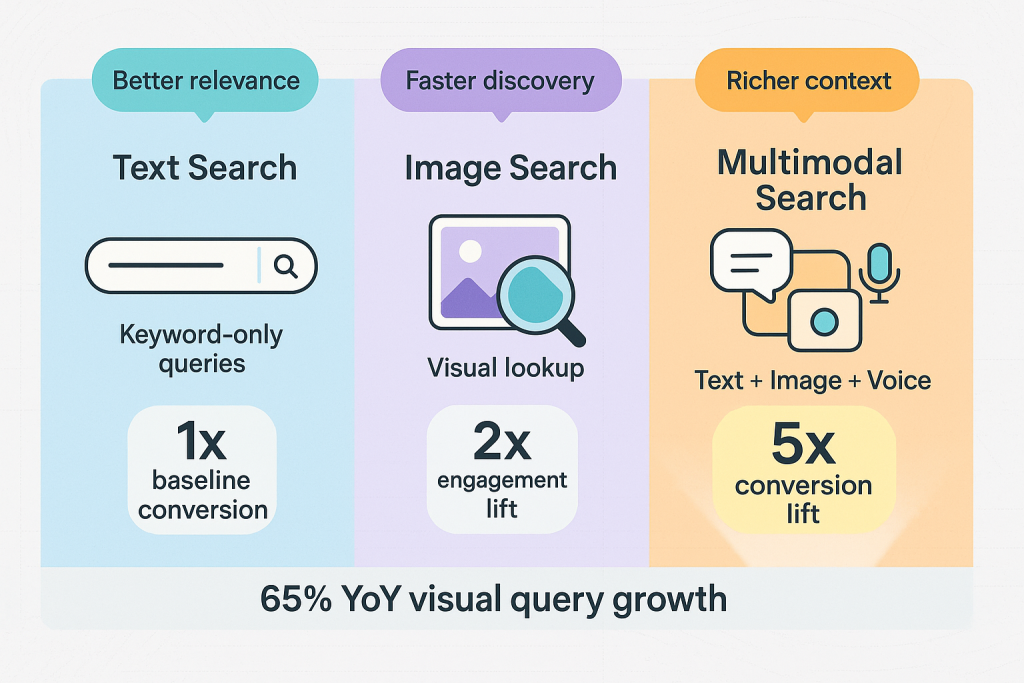
Multimodal search combines text, image, and voice inputs into a single query, enabling richer, more relevant results and cutting bounce rates. As visual‑voice queries gain 65% year‑on‑year growth on Google, brands applying properly tagged images, structured data, and unified UX see up to 5 × conversion lifts and deeper funnel engagement.
Overview at a Glance
| Modality | What It Enables | Brand / SEO Impact |
| Image+Text Search | Visual query with “under 50 INR” | Surfaces products users can’t describe |
| Voice+Text Query | “Show me this near me” + picture | Boosts local intent and foot traffic |
| Screenshot + Ask | Screenshot UI plus typed context | Engages yet‑to‑convert browsers |
| Video Snapshot | Pause video & query visually | Enhances user awareness and retention |
| Multi‑Intent Fusion | Cross‑context discovery | Increases loyalty & time‑on‑site |
Multimodal Search: How Brands Can Leverage It for Growth
Table of Contents
- What Is Multimodal Search?
- Why It Matters for Brands: Trends & Stats
- Real‑World Examples: Google, Bing, Pinterest
- SEO & Content Optimization Tactics
- Implementing Multimodal for Your Brand
- Tools & Tech Platforms to Use
- FAQ
- Bonus Download & CTA
1. What Is Multimodal Search?
Think of multimodal search as letting your customer show what they mean instead of typing it. It merges OCR, computer vision, LLM-based understanding, and keyword search into one smart result. Google calls it Multisearch, Bing calls it Visual Search, others call it Vision + NLP fusion all pointing to the same idea: search that understands images, text, voice, and context in one query.
2. Why It Matters for Brands: Key Trends & Stats
Multimodal search isn’t future tech, it’s happening fast.
- Visual + screen-based queries rose 65% year‑over‑year on Google in mid‑2025 (PPC Land).
- Google’s AI Overviews (which power multimodal/synthesized responses) drive a 10% lift in usage for compatible queries (Semrush).
- Within e‑commerce, onsite search accounts for 44% of revenue; multimodal search boosts that further (constructor.com).
- In SEO-heavy categories, AI search visitors deliver 4.4× higher value per visit than traditional search users (Semrush).
Action: If brand visibility, voice‑image tagging, and structured data aren’t part of your 2025 roadmap, you’re leaving easy traffic and conversions on the table.
3. Real‑World Examples: Google, Bing, Pinterest
| Platform | Use Case | Benefit |
| Google Lens / Multisearch | Upload image + “near me” | Local businesses capture high‑intent leads |
| Pinterest Visual Search | Tap & “find similar” | Drives inspiration, increases revenue |
| Bing Visual Search | Snap real‑world scene | Brand exposure to desktop AI+voice users, especially on desktop where many visual clicks originate (searchenginejournal.com, blog.google) |
| Retail Fashions (ASOS, Zalando) | Image + style filter | Shortened path from inspiration → cart item |
| Consumer Tech & Food | Image of dish + “recipe” or “where to buy” | Multimodal funnel bridging intent to action |
Mini intro: These platforms fuse image, text, and context in immersive ways making “point and click to buy” not just possible, but expected.
4. SEO & Content Optimization Tactics (AEO, GEO, Technical)
Key tactics:
To optimize for multimodal search, begin by aligning multimedia assets and page schema with query intent. That includes high‑res images, image captions, alt text with long‑tail modifiers (“linen shirt” + “near me”), voice‑search FAQs, structured Product/Article/LocalBusiness schema, and fast mobile UX. Don’t forget to make captions and transcripts crawlable.
Quick facts:
- Use high‑resolution, fast-loading images named with keywords
- Add image alt text like: “linen shirt 2025 collection”
- Include voice-search friendly FAQs or speak‑able metadata
- Implement Schema.org markup for each page’s use case
Action: Audit your hero images, alt texts, schema then add captioned transcripts or FAQs for voice assistants.
5. Implementing Multimodal for Your Brand
Step by Step:
- Inventory your content: List pages with strong visual or voice appeal (product pages, places, dishes).
- Tag assets: Name files descriptively (e.g., linen-tshirt-black.jpg), add alt text and captions.
- Add Structured Data: Use Product, Offer, LocalBusiness, and ImageObject schema matching your content.
- Add voice-query cues: Pre‑answer questions like “What is this?” or “Nearby stores?”
- Test your content: Use Lens / Bing image search to preview discovery paths.
Use internal links:
- Case Studies showing brands who beat last-mile drop‑off.
- We offer branding and consulting services.
Tip: Keep each bullet under 60 words, each paragraph one thought.
6. Tools & Tech Platforms to Use
Overview paragraph:
Modern brands don’t need to build multimodal capability from scratch. From fast‑set cloud APIs to plug‑and‑play platforms, there’s a spectrum. Some tools help craft annotated image + voice datasets, others layer in user‑context embedding from OCR or UGC. Choose platforms aligned with your catalog size, dev resources, and channel strategy.
Quick list:
- Fast Simon GenAI Search – 30% conversion lift using image‑text hybrid indexing (TechWyse Internet Marketing)
- Marqo or Algolia + BERT/OCR API – lightweight insertion into existing storefronts (marqo.ai)
- Pinterest Performance+ & Visual Tags – auto‑create ads that leverage visual discovery with 11–20% ROI lift (Pinterest)
- Google’s Cloud Vision + Structured Snippet APIs – feed certified images into Lens/Open Gallery
7. FAQ
What is the multimodal search branding benefit?
Multimodal search lets your customers search visually and by voice, so products get discovered even when keywords fail—boosting traffic, engagement, and conversions.
Does Google Multisearch hurt SEO rankings?
No. It does not change ranking algorithms. Instead, it rewards sites with well‑tagged images and structured data.
Which businesses benefit most from multimodal search?
Retail, food, local services, fashion, tourism, and packaged goods with visual identity or location cues, see the greatest lift.
Is voice plus image search effective for small businesses?
Yes, especially with ‘near me’ visual searches. Proper alt‑tags and schema make small shops discoverable.
How soon can I see ROI from multimodal optimization?
Brands often report visible lifts in 4 – 6 weeks, especially when onsite search and product pages are involved.
What’s the difference between multimodal search and image-only search?
Image-only returns visually similar items. Multimodal combines image, voice, or typed context to refine by price, location or attribute.
8. Bonus Download & CTA
Infographic: “Multimodal Search Overview”
Download the infographic to illustrate the power of text, image, and voice fusion in one visual:
Download the Infographic
PDF Checklist: “Multimodal Search Optimization Checklist”
Grab the fill-in-the-blanks PDF to optimize your blog assets (image filenames, alt-tags, schema snippets, voice prompts, and UTM-ready CTAs):
Download the PDF Checklist
Want multimodal search built in 4 weeks? Chat with our integration team or explore our services.
Summary
- Multimodal search (image + text + voice) is rapidly becoming mainstream with 65% YoY visual query growth, 10% uplift via AI Overviews, and 4.4× higher visitor value over traditional search.
- Brands that optimize images, schema, alt‑tags, and capture voice‑based intent can rank prominently in AI‑driven discovery paths.
- Use the downloadable checklist, test interactive voice–image workflows, and level up your content strategy.
Need help with integration or brand-level implementation? Let’s chat on turning your JPGs and voice searches into brand‑driven revenue
Author Bio
Balamurugan S is an SEO Lead with over 6 years of experience helping local brands drive organic growth and integrate AI-powered solutions to scale their digital presence.


